
← Back to home

Project Case Study

AZERBAIJAN  •  DRILL CUTTINGS TREATMENT

In Azerbaijan, all major drill-cuttings treatment technologies have been evaluated head-to-head, and HydroPure has emerged as the leader.

Within a 6-kilometer radius in Azerbaijan, all major technologies have been used to process and recycle oil-based and synthetic-based drill cuttings produced by British Petroleum, SOCAR, and Azneft.

Before 2017, AA Services operated multiple TCCs to process synthetic-based drill cuttings produced by British Petroleum. However, AA Services could not keep pace with the volume of drill cuttings being generated. In 2017, Azerbaijan’s national oil company, SOCAR, decided to build a new waste treatment facility to address the growing stockpiles. A SOCAR subsidiary, SOCAR Waste Management, built the facility using Econ VacuDry thermal desorption systems. According to Econ, it was the largest drill-cuttings plant in the world.

Shortly after the VacuDry plant was built, SOCAR determined that the systems were not achieving the flow rates promised by Econ. Despite spending tens of millions of dollars on the plant, SOCAR continued to face growing drill-cuttings stockpiles because the facility lacked the capacity to treat the material as quickly as it was produced.
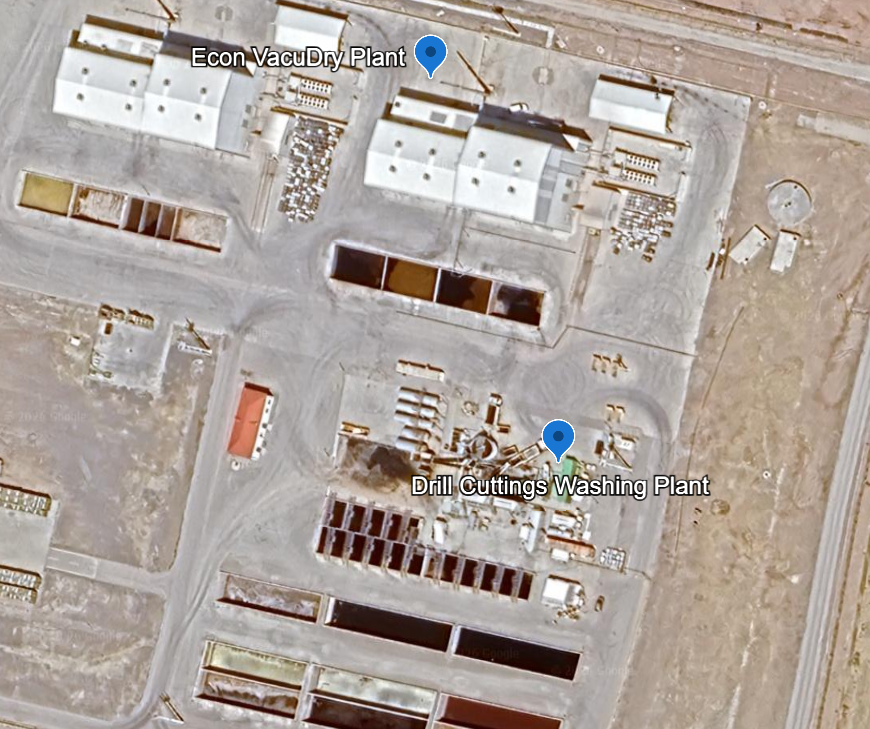
Satellite overview identifying the Econ VacuDry Plant and Drill Cuttings Washing Plant

Another local company was brought in to operate a drill-cuttings washing system purchased in England. The plant was installed at the same site as the Econ VacuDry facility. However, the technology could not recover usable oil from the cuttings, and the cleaned material did not meet landfill standards. The facility continued operating, but it processed only diesel-based drill cuttings at a very low production rate.

After the washing technology failed to meet requirements, SOCAR still needed a solution capable of keeping pace with drill-cuttings production and reducing the stockpiles awaiting processing.

SOCAR representatives then contacted HydroPure for help increasing the treatment facility’s production capacity. HydroPure was successfully operating an oil-sludge treatment plant in Azerbaijan and had become a trusted technology partner for SOCAR. HydroPure evaluated the Econ VacuDry system and the cuttings-washing plant. The company determined that the VacuDry system could not be modified to increase production because it used a batch process. HydroPure also concluded that the washing plant was not a viable solution for recycling synthetic-based drill cuttings.
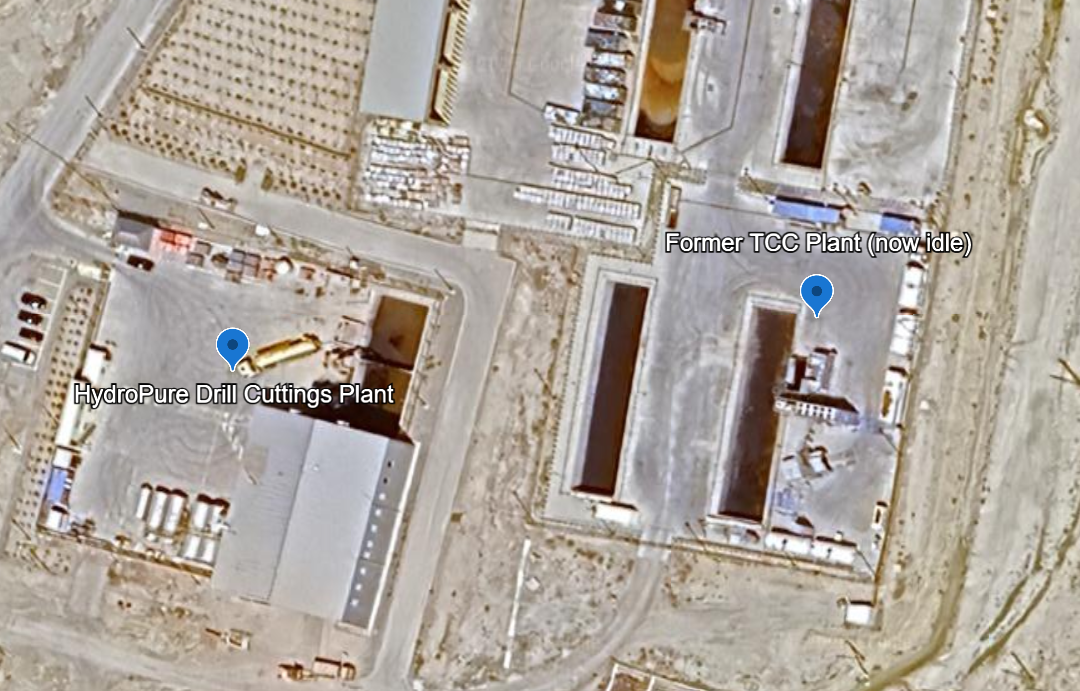
Satellite overview identifying the HydroPure Drill Cuttings Plant and former TCC Plant

SOCAR Waste Management then asked HydroPure to submit a proposal for a new drill-cuttings processing plant based on HydroPure’s paddle-dryer technology. In 2019, HydroPure received approval to build the plant at a SOCAR facility. Construction began in January 2021, and the plant was operational by July. Immediately after commissioning, the HydroPure system began processing more cuttings per day than all the other plants combined. After five successful years of operation, the Econ VacuDry plant is used only sparingly, the TCCs are not in use, and the cuttings-washing plant is no longer operating.

The fact that HydroPure was invited to build a plant in Azerbaijan demonstrates that the competing technologies had not met SOCAR’s operational needs. If any of those systems had been able to keep pace with demand, HydroPure would not have been authorized to build a new plant. Today, HydroPure’s plant operates at full capacity, while the other technologies are either idle or used only on a limited basis.

The following is a brief description of each competing technology.

TCC (Thermo-mechanical Cuttings Cleaner)

TCCs were developed to treat drill cuttings on offshore drilling platforms without using a flame to generate heat. These systems use friction from grinding hammers to raise the temperature of the cuttings until the oil and water vaporize. TCCs are well suited for hazardous locations where open-flame burners are not permitted.

The primary disadvantage of these systems is their inefficiency. They convert diesel fuel into mechanical energy to generate friction, and the efficiency of that conversion is only about 25%. These systems also require major rebuilds every few months, cannot handle cuttings with high water content, and produce poor-quality recovered oil and water. Three such systems would be required to match the production capacity of the proposed HydroPure process.

Indirect Rotary Drum Dryers (RLC and Other Manufacturers)

Indirect rotary drum dryers consist of a rotating drum inside a large oven. Burners heat the outside of the drum, which rotates to move material through the dryer. These systems are commonly used to treat contaminated soil.

These systems use very high surface temperatures because flames directly contact the drum’s exterior. Because the drums have limited heating surface area, they rely on extreme temperatures across relatively small heating surfaces to achieve the required heat transfer. These high temperatures can damage the base oil, preventing its reuse in fresh oil-based mud (OBM).

Econ Vacudry Thermal Desorption

The Econ VacuDry system is a batch process that involves filling a 10-cubic-meter vacuum vessel and heating the material until all oil and water have evaporated in a high-vacuum environment. The vacuum enables the water and oil to evaporate at lower temperatures, allowing high-quality oil to be recovered.

The primary disadvantages of this system are its extremely high cost and low production rate. The vacuum vessel has less than 30 square meters of heating surface area, resulting in long batch times. As the water evaporates and the level of the cuttings falls inside the vessel, the surface area in contact with the material decreases. By the end of the batch cycle, less than 10 square meters of surface area remains in contact with the cuttings. The batch process is also inefficient because of the time required to fill and empty the vessel.

Discuss your drill cuttings treatment requirements with HydroPure.

Start a Conversation